
Details
An ERP for Indian manufacturers with eighty people, where the owner had never once opened the software he was paying for.


Part 01
Overview
An ERP for manufacturers with eighty people, not eight hundred
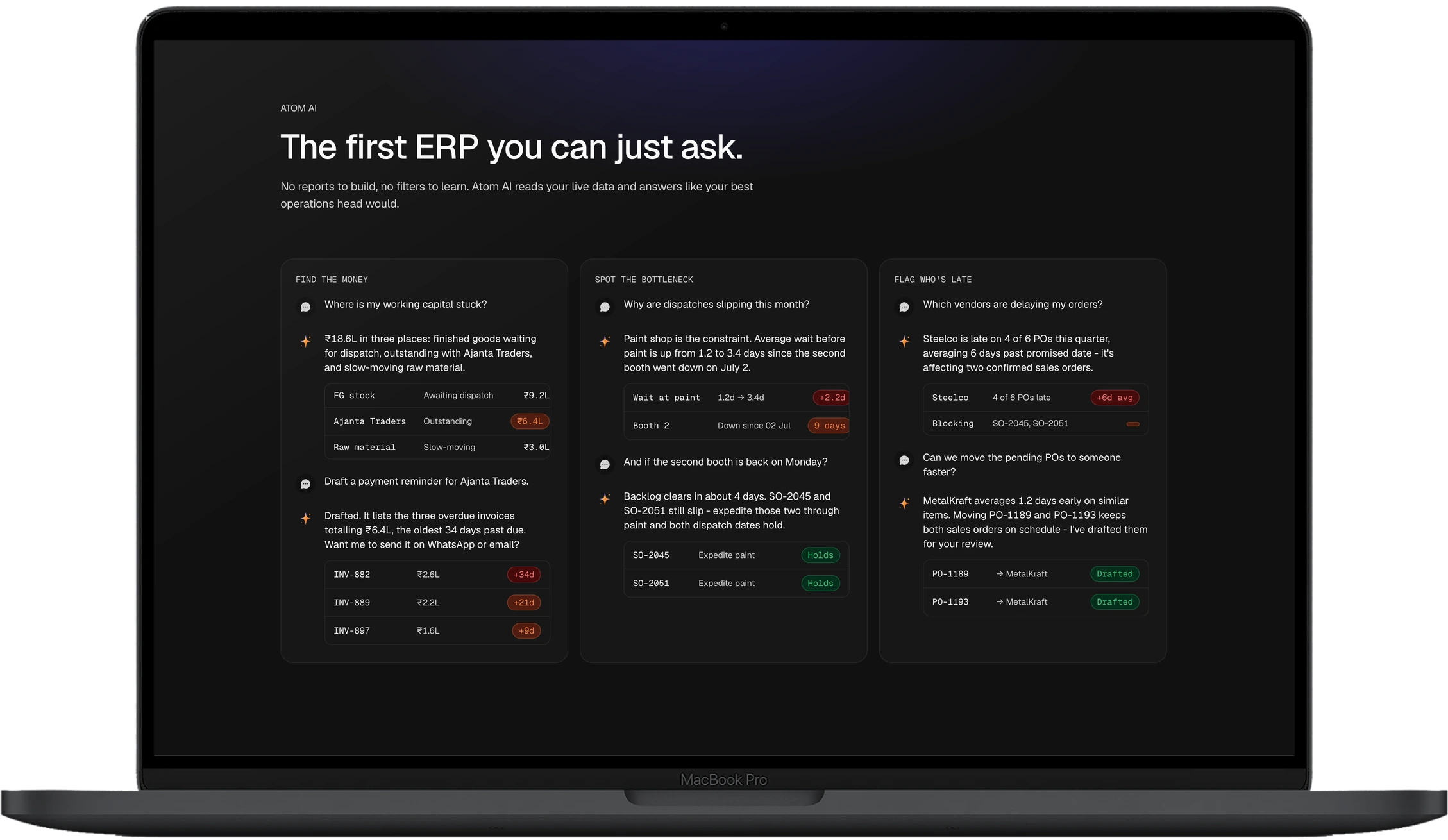
It runs the same things every ERP runs: stock, production, quotations, dispatch, compliance. With one difference: you can ask it.
The owner opens a chat and a morning brief instead of a dashboard he was never going to learn.
Part 02
Problem
The software nobody opens
An ERP is supposed to be the place a business keeps the truth about itself. What was ordered, what was made, what shipped, what’s left, what’s owed, what broke.
A factory with eighty people has the same questions and none of that structure. There is no ERP department. There is one person who learned the software, and everybody else goes through him.

What the category never solved.
Part 03
Research
We asked to see the software. They called somebody
N manufacturing units across N industries (cable manufacturing, sugar milling, others) in cities. We went to the factories rather than taking calls.
Each visit had the same shape: talk to the owner, then ask to see the software. Owners described a system they used. When asked to show it, they called somebody.
Five things I needed to find out.
Three factories, three impossible requirements
Every factory we visited had at least one thing it needed that no ERP could do. They were never the same thing twice.
-
Factory 01 · Cable manufacturing
The quotation that isn’t a document.
What happensThe quote goes out with a CAD drawing, which is what specifies the product. Their ERP holds rows and a total, so the drawing travels on WhatsApp.
What the software assumedThat a quotation is a list of line items. For an engineered product it is a specification, and the specification is a picture.
What the structure needs · D03A document is content, not an attachment. The drawing travels and versions with the quote.
-
Factory 02 · Sugar milling
The customer who is also you.
What happensThe owner runs three or four companies. One floats a quotation; another answers it. A purchase and a sale, in two books that both have to stand up.
What the software assumedThat customers and suppliers are other companies. An Indian promoter group isn’t shaped like that and never was.
What the structure needs · D03An entity can be on both sides of a transaction. Promoter groups are the normal shape of this market.
-
Factory 03 · Maintenance, everywhere
The log that only matters on one day.
What happensService intervals slip while the line runs. Nobody records what was missed, because recording it creates the evidence. Then an inspector asks for the history.
What the software assumedThat compliance is a module you open. In practice it’s a record you need to already have.
What Atom does · D04The log is a by-product of work already entered. On the day the inspector asks, it exists.
The thing each business needs most is the thing most specific to it.
A product built from the average of all of them will be wrong for every single one.
What I learned.
- 01
The factory already had a natural-language interface to its ERP. It was a person.
What we sawHe asks the man, and the man tells him. Several times a day, in every factory, with a salary attached.
What it forcedNot adding AI to an ERP. Building an interface the business had already invented.
- 02
He doesn’t need a conversation. He needs the same five answers, before he asks.
What we sawStock, that order, shipped, pending, due. Usually asked because something already went wrong.
What it forcedA morning brief before a chat box.
- 03
Every factory is an edge case, and the edge is the part they care most about.
What we sawThe drawing, the quote your own company answers, the log nobody keeps.
What it forcedA shape that bends: a structural decision, not a configuration screen.
- 04
The person keeping the system alive is the only one who gets nothing out of it.
What we sawHe keys in every receipt and dispatch. The decisions happen in another room.
What it forcedEntry had to get cheaper and give something back, or the AI lies confidently.
- 05
Nobody chose their modules. A salesperson chose for them.
What we sawOwners know what they pay and who sold it. Not what they bought.
What it forcedConfigure from what the factory does. Let it start small.
The factory already had an AI. It was a person, and it cost a salary
He’d ask a question out loud. Someone who understood the software would go and look, and come back with the answer.
Natural language in, plain answer out. With a person in the middle: slow, expensive, and unavailable at nine at night.
How it works todaySeveral times a day · office hours · a salary
What we builtSame question, same answer
We didn’t invent the interface. We removed the person standing in it.
So the question became: what does the software look like if the owner asks it directly?
Three people, one record.
- The owner. Pays for it. Has never opened it.
- The one who knows the software. Reads it aloud to everyone else.
- The data-entry operator. Keeps it alive. Gets nothing back.
An AI reading degraded data answers confidently and wrongly, and the owner has no way to tell.
What I was solving for wasn’t better ERP software.
The brief
It was letting a manufacturer ask his own business a question and get an answer, without a person who knows where the answer is kept, and without assuming his factory is shaped like anyone else’s.
Part 04
Decisions
The brief before the box
Answers before questions, not a chat window.
The obvious build is a chat window on the database. Every ERP vendor shipped it in the same eighteen months.
He asks where an order is because a customer has already called. Every question he asked was a lagging indicator.
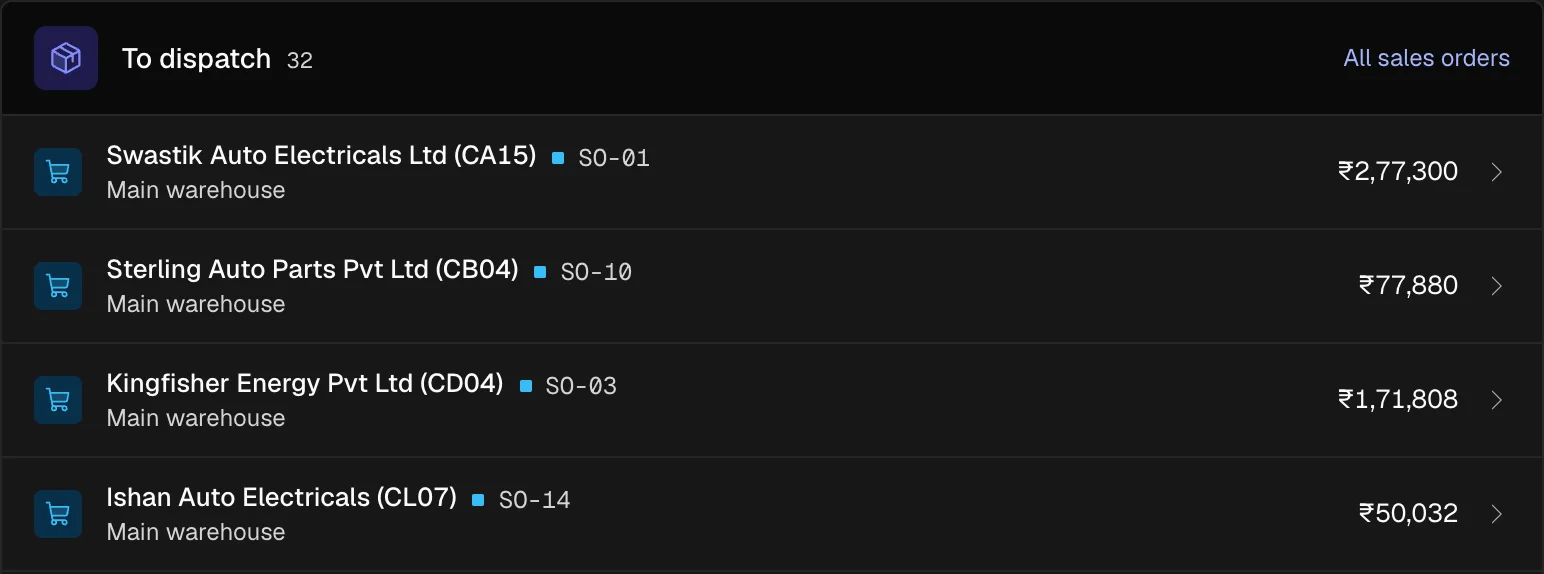
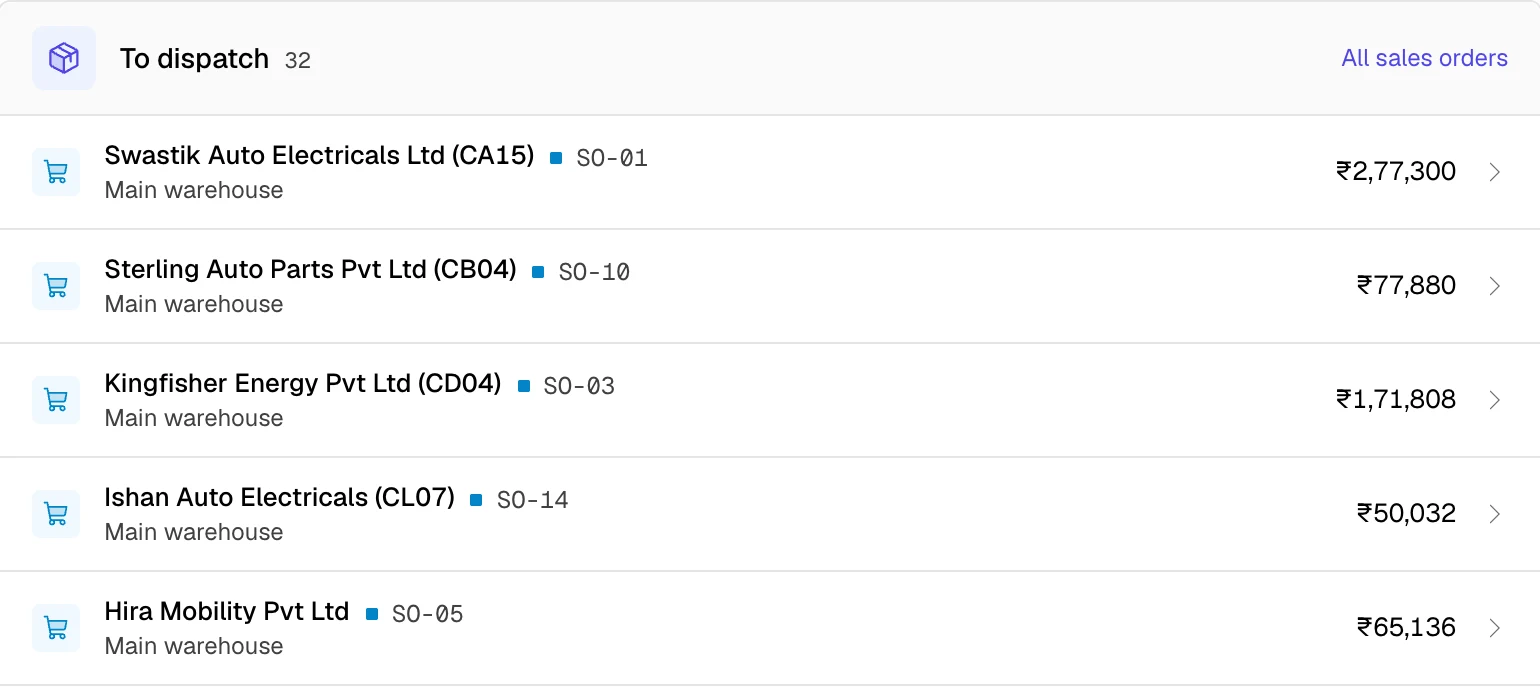
A morning brief first: what needs him today, in the order it needs him. Then the chat, underneath, for everything else.
How the brief ranks what matters: ranking logic a quiet day


Don’t sell modules, grow them
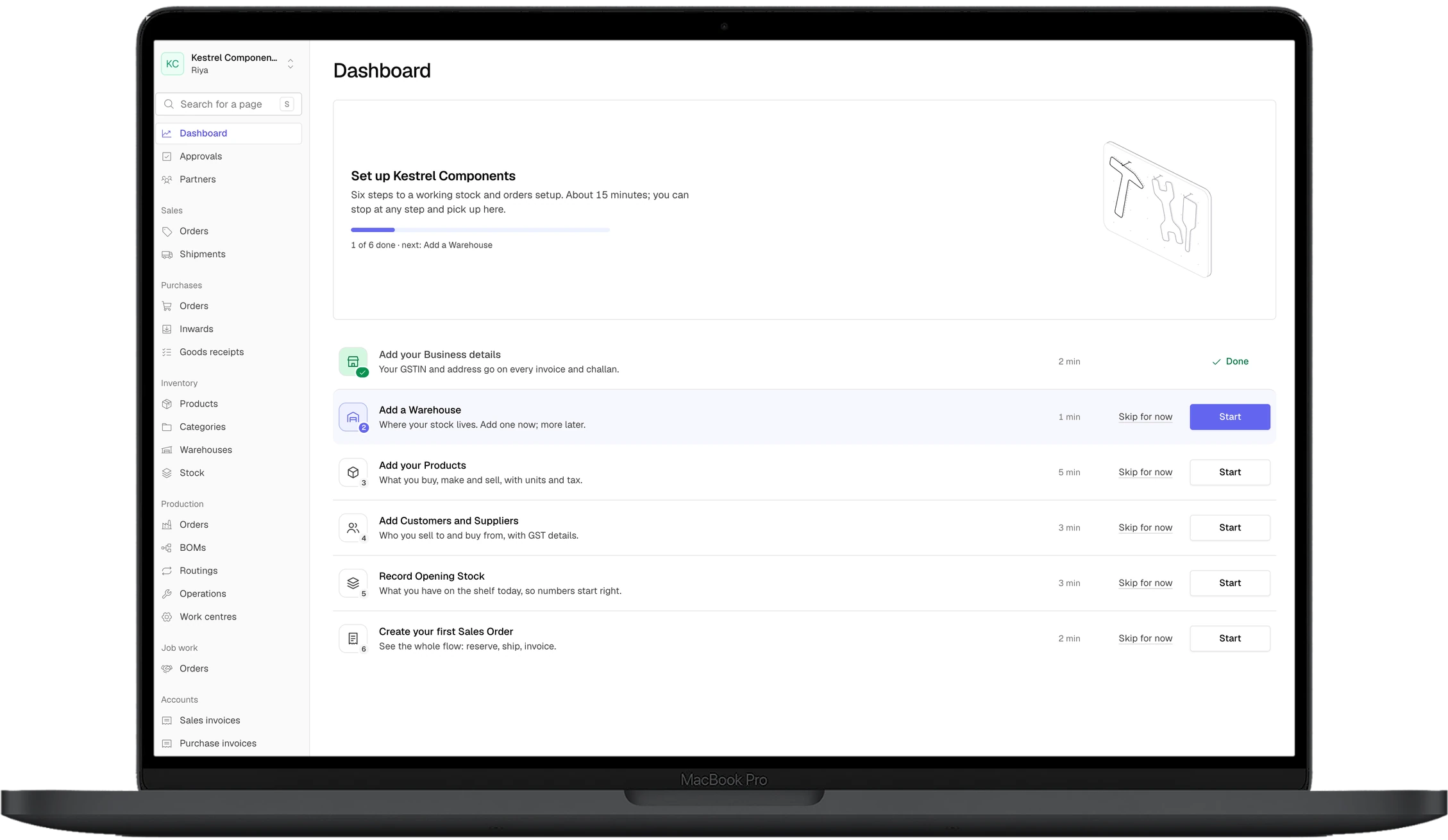
The system configures itself from the work.
He was asked to specify a system before he’d used one, by someone paid to sell him more.
Start with what every factory does, watch the work, and offer the next module when it would obviously help.
What every factory starts with: base modules

Every factory is an edge case
The architecture that bends.
The next factory will have a fourth thing you’ve never heard of. So: what has to be true about the structure so that the fourth thing doesn’t need us?
- A document is content, not an attachment.
- An entity can be on both sides of a transaction.
- Any object can carry a record of what should have happened.
- A factory’s own vocabulary survives. confirm
The structure underneath: architecture
The record that writes itself
Compliance as a by-product, not a module.
Every ERP already has a compliance module, and the module is empty.
A machine stopped, a part issued, a technician assigned. Each is already a transaction somewhere.
The record assembles itself out of things people did anyway. The e-way bill comes from the dispatch already being entered.
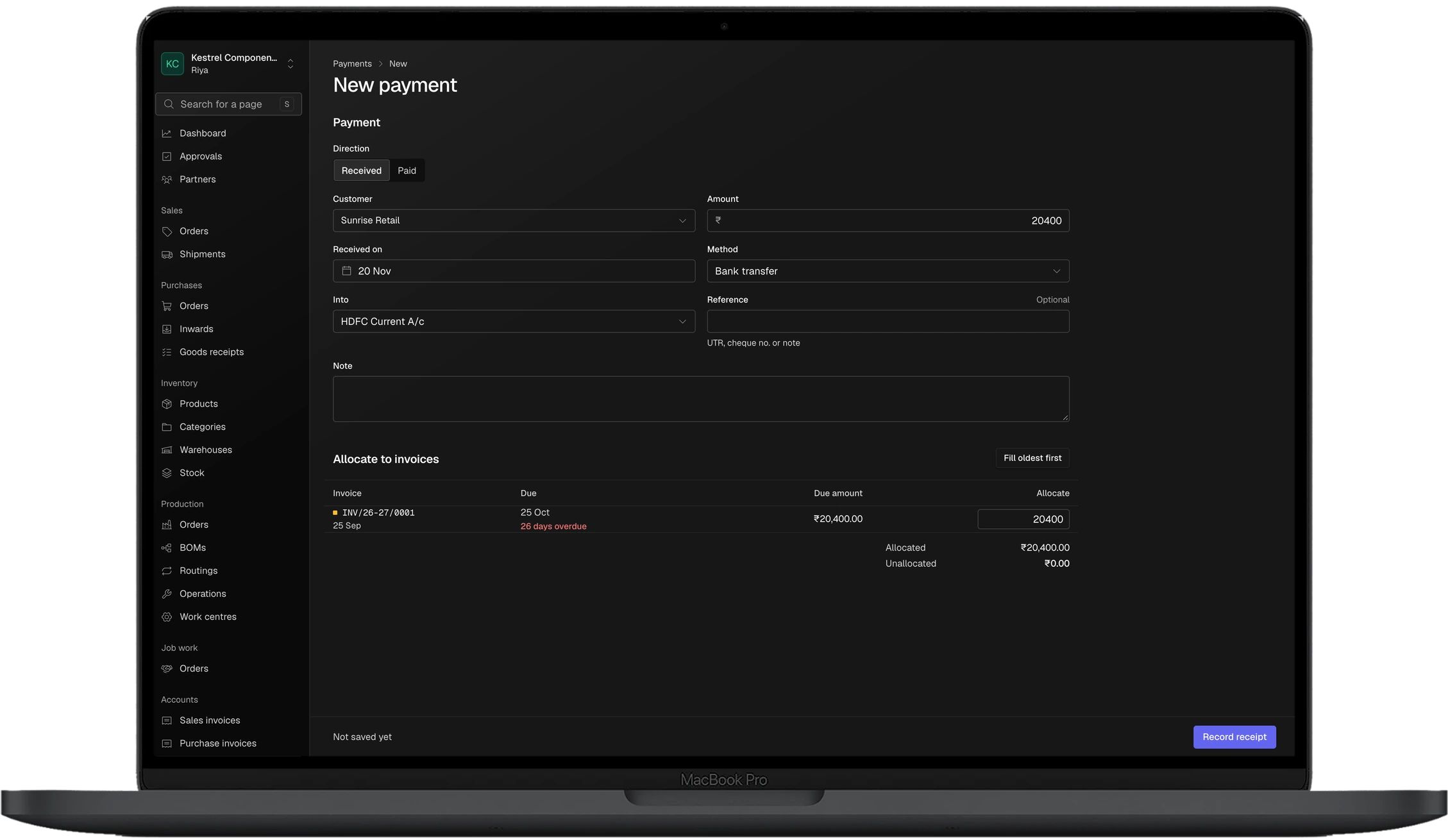
The same move, shipped: each record drafts the next.
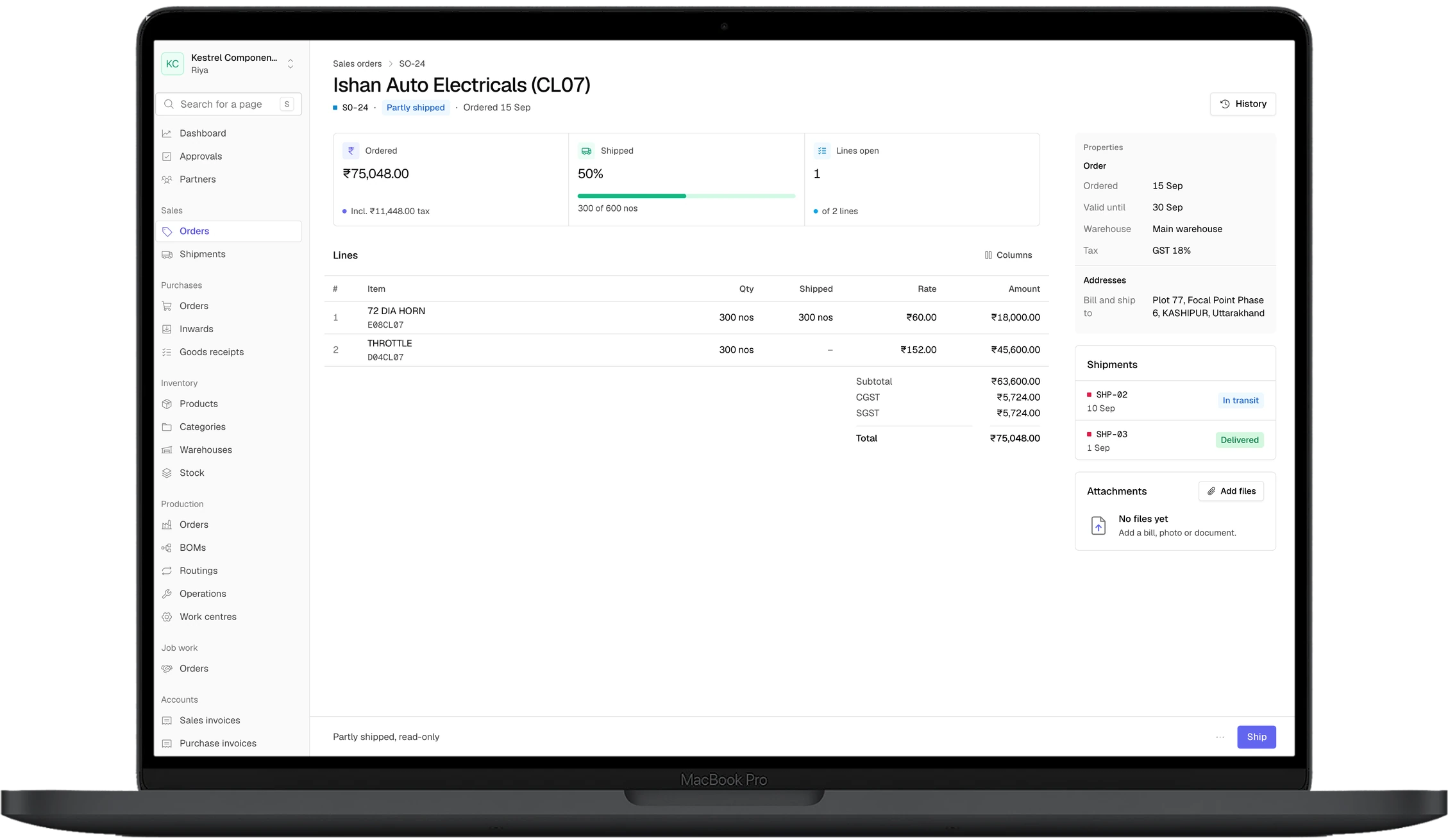


 OrderHalf shipped. The footer offers one thing: Ship.
 ShipThe draft lists only what is still to go.
 InvoiceBilled from the shipment, linked both ways.
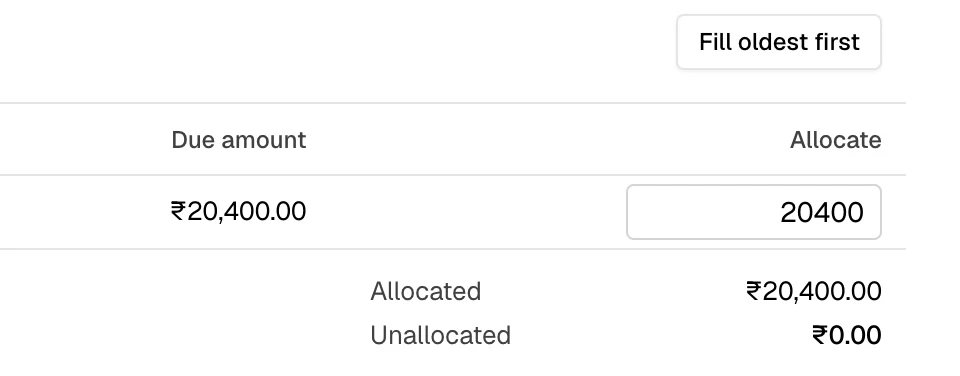 Get paid“Fill oldest first” settles the overdue bill.
Two models and a memory
What a question costs.
The first version used one strong model for everything. It was accurate and it was unaffordable.
We cached the reasoning, not the answer.
The data goes stale in minutes. The way you work out the answer doesn’t.
The brief asks the same questions every morning, so it is the cheapest thing in the product. The decision made for the owner also made the economics work.
Cost per question, before and after: ___ Answered from saved logic: ___%
Part 05
Design
The system under the screens. Thirty screens that feel like one place
Built for AtomERP, and for AtomGo, the inventory product coming behind it.
An ERP is not one product. It’s thirty screens that all have to feel like the same place, built over years, by people who won’t all be in the room.
Building a system for the second product before the second product existed was the only way the second product was ever going to ship on time.
 The full system · its own pageView design systemComponents, templates and rules for AtomERP and AtomGo, with every token and state.
Colour: one for action, the rest has to mean something
Neutrals carry the screen. Indigo-500 fills the one primary action and draws the focus ring. Everything else with a hue is data or status, and status always comes with a word.
Primary · indigo
Secondary · cobalt
Neutrals · surfaces, lines, ink
Status · text, solid, soft, and always a word
Charts · six hues in a fixed order, never cycled
Type: Geist, two weights, ten sizes
Weights 400 and 500 only. Sentence case everywhere, tabular figures in every column of numbers, and Geist Mono for anything someone reads aloud down a phone line.
text-display28 / 34 · 500 · −0.025emPage titlesPurchase orderstext-figure28 / 32 · 400 · −0.03emHeadline figures, tabular₹18,42,650text-title18 / 24 · 500 · −0.015emSection and widget titlesOrdered vs receivedtext-heading14 / 20 · 500Panel titlesTo dispatchtext-body14 / 20 · 400Everything you readCouldn’t save. Check your connection and try again.text-body-sm13 / 18 · 400Table cellsApex Engineering Workstext-label12 / 16 · 500Column headers, field labelsOn handtext-caption12 / 16 · 400The line under a figurePast their expected datetext-code12 / 16 · 400Anything read aloudSO-0001 · PO-72text-micro11 / 14 · 400StockMeter’s caption18 below reorder point
Phones step up: m-title 24 / 30 · m-body 15 / 22 · m-label 13 / 18
Spacing: a 4px grid, 24 between blocks
Every gap in the content area is a multiple of four. Page blocks sit 24px apart, measured content to content; inside a block the gaps tighten to 8 or 12. A conformance check measures the 24 to within a pixel.
--space-14The base unit. Every gap is a multiple of it--space-28Inside a block--space-312Inside a block · table cell padding--space-416Page padding on phones--space-520Between line tabs--space-624Between page blocks · rule L1--space-832Page padding from tablet up--space-1248Record page gap, wide screens
Inside one button · enlarged
--control-md- 32 Height. Controls come in 28, 32 and 40.
--space-3- 12 Padding each side, on the grid.
--icon-md- 16 Icon, following the label colour.
control internal- 6 Icon to label. Control internals are the one place allowed off the 4px grid.
--radius-sm- 4 Radius. 4 on anything you click, 6 on anything that holds content.
text 13 · 500- 13 Label, and it says what it does: verb plus object.
Radius · from one 6px value · corners drawn at 4×
--radius-xs2--radius-sm4 · click--radius-md6 · hold--radius-lg8
Elevation · hairlines first, shadows only for what floats
--line1px · surfaces--shadow-xssegment, toggle--shadow-popmenus, popovers--shadow-sheetbottom sheets
Components: eight of the 117
Rebuilt here from the system’s own tokens rather than screenshots, so they change theme with the swatches. Most of them work.
One component, all the way down.
StockMeter shows how much of something you have. The obvious design is a bar: filled, coloured, red when low.
A sentence, not a bar.
The figure, the unit, and one line saying what it means: “34 below reorder point.”
A bar is a picture you have to read. A sentence isn’t.
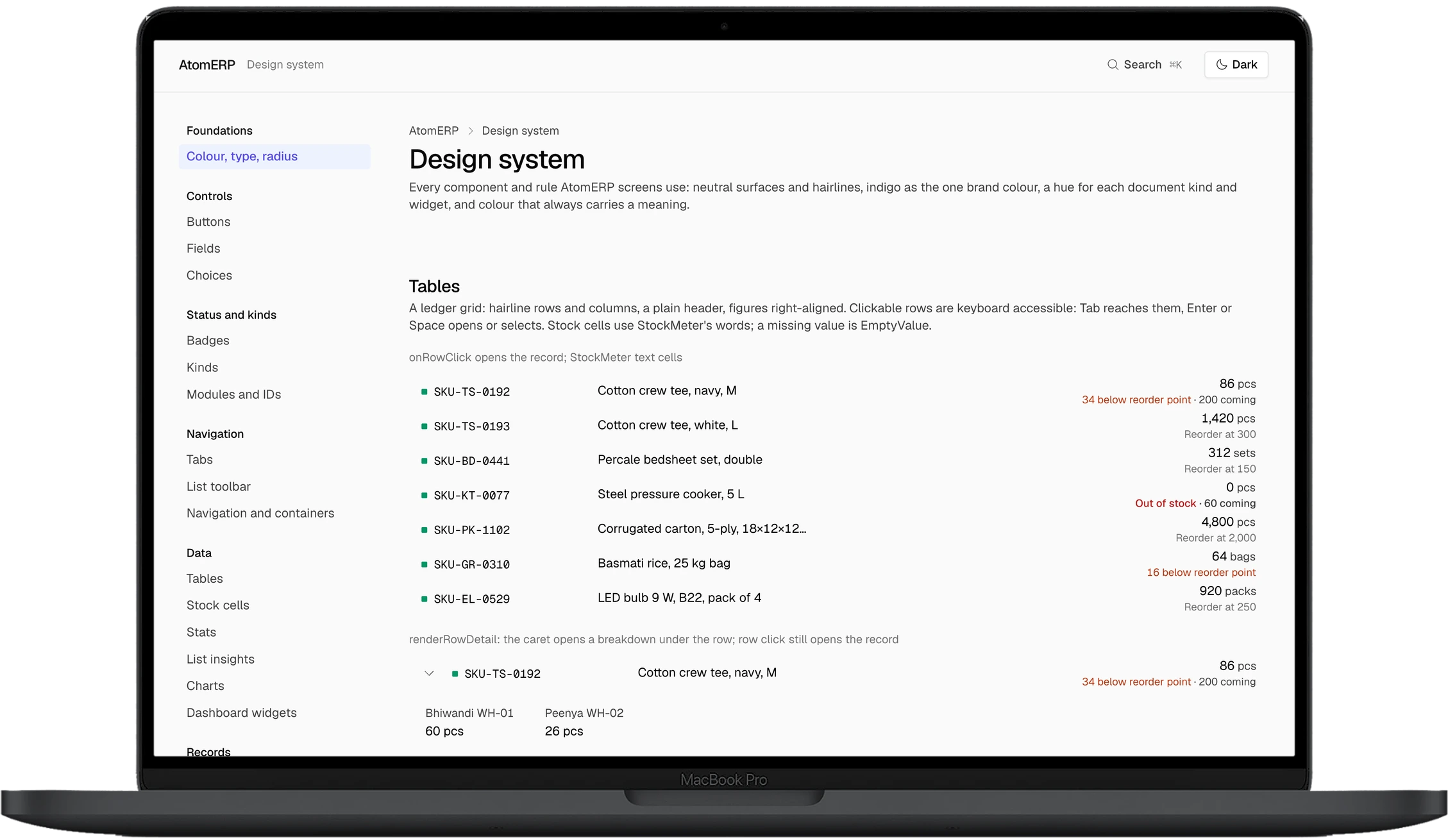
The man reading it at the stores counter gets the same answer as the owner reading it on his phone, and neither of them has to work anything out.
That’s the same decision as the morning brief, two layers down: don’t show the data and hope. Say what it means.
Anatomy · point at a number
- Figureen-IN grouping, tabular.
text-body-sm13 / 18 in--ink. Never coloured. - Unit
text-label12 / 16, regular, in--ink-muted. - Caption
text-micro11 / 14. The state, in words:--ink-subtle,--warningor medium--critical. - Incoming“· N coming” in
--ink-muted, only when something is on order. - EdgeRight-aligned. Quantities line up on the right, in a 112px column.
States · drag the stock level
Shipped · a sentence
Rejected · a bar
ok Caption “Reorder at N” in ink-subtle. Nothing to do yet.
--ink--ink-muted--ink-subtle--warning--criticaltext-body-sm13/18text-label12/16text-micro11/14--row40--space-312 cell--col-qty112
The cost: a sentence needs more room than a bar, so every quantity column is 112px wide, wherever StockMeter appears.
One component, three readers
Every one of the 117 components carries metadata a model can read: what it’s for, its props, what to avoid, and hints for choosing between components. A build script refuses to pass when a documented prop doesn’t exist or a component isn’t shown on the live reference page.
01 · A person
02 · A model · components.json
"antiPatterns": [{
  "scenario": "A bar without a scale in a table cell",
  "reason": "A bar with no axis says nothing about how much is enough; the caption does.",
  "alternative": "StockMeter (text-first)."
}, {
  "scenario": "Colouring the figure itself",
  "reason": "The figure stays ink; only the caption carries warning / critical, and it says the state in words."
}]03 · A build script · check-design-system.mjs
report('PROP', `${m.mf}: ${m.name}.${p} not found in ${f}`)
report('TOKEN', `${m.mf}: ${m.name} names --${t}, not in styles.css`)
report('SHOWCASE', `${m.name} (${m.mf}) is not used on /design`)Written once, for a designer, a model and a build script.
Each principle traces back to a factory.
One system, two products
No component names a colour, so AtomGo was one ramp and one font family away. A product is a palette and a vocabulary. AtomGo’s screens took N days

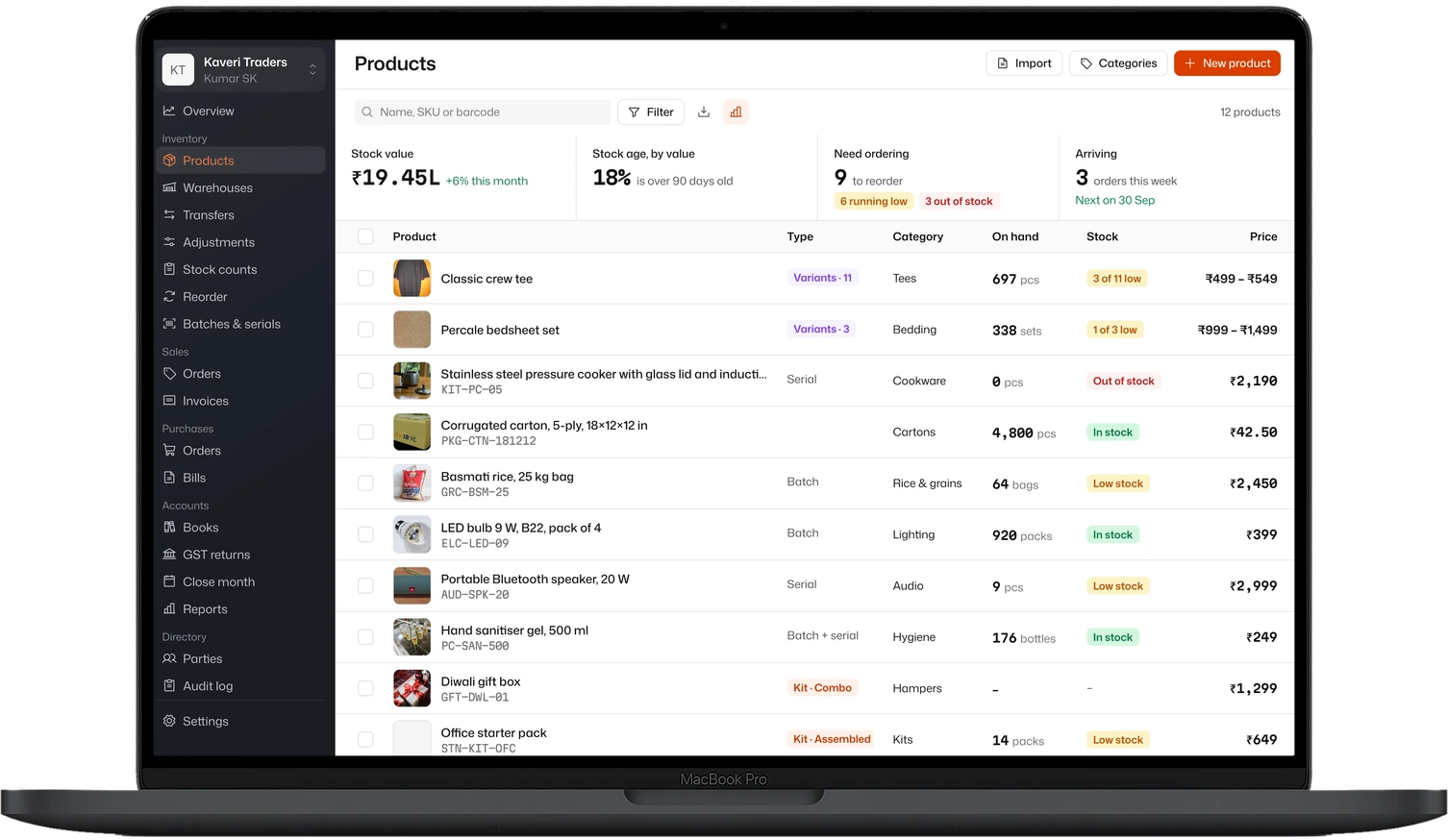
One file changed. Everything else is the same system.
Part 06
Impact
No numbers yet, by design. Status: concept · pilot · live
The measures the work was committed to, left open until there are real figures.
Part 07
Learnings
What I’d do differently.
- 01I believed the chat box longer than I should have.
The problem wasn’t answering questions. Every question arrived too late.
- 02I treated the person who knows the software as a persona.
He was closer to a gatekeeper. if true
- 03the data-quality learning
The system rests on entries from someone who gets nothing back. what I did about it
- 04an unsolved problem
Still open: stated precisely
What could kill it.
Nobody in these factories thought anything was wrong. The owner had a way of finding things out. It involved walking to a door and asking a man a question, and it had worked for twenty years.
Question, person, software, person, answer.
Written down, it looked like something a machine should have been doing all along.
Scene photography is illustrative and AI-generated; screens, flows and research are from the product.